






Total Cost of Ownership (TCO) Model for Storage

Performance-based TCO provides a more accurate way to evaluate storage by measuring the cost of getting work done—not just the cost of infrastructure. Traditional models often overlook how performance, time to completion, and system efficiency directly impact total cost.
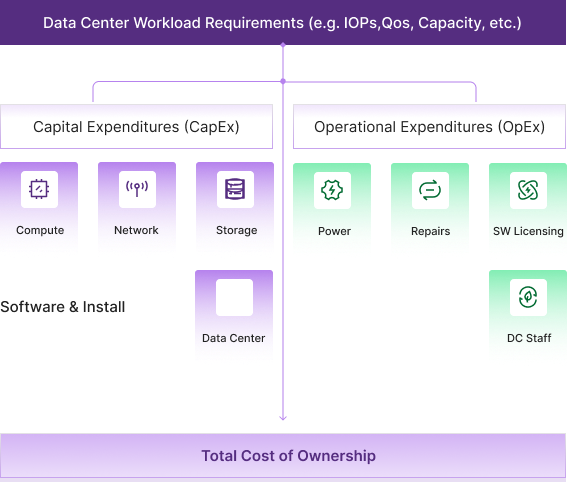
This page introduces the performance-based TCO model and shows how it can be applied. The diagram below outlines the key factors that influence cost, while the white paper and calculator enable you to evaluate real-world scenarios, quantify workload costs, and compare software and hardware-accelerated approaches.
What Goes Into a TCO Model?
Performance-based TCO reflects the full cost of running workloads by incorporating performance, time to completion, and resource utilization—not just infrastructure cost. As shown in the model, factors such as CPU usage, processing time, and data efficiency directly influence total cost.
A wide range of inputs contribute to TCO, including system performance, endurance, and total capacity. This model normalizes cost as TCO $ / TBe / rack / month, enabling consistent comparisons across deployments. Workload-specific factors such as capacity utilization, error encoding, replication, and data reduction can significantly impact results, while performance-driven analysis highlights how faster technologies, such as SSDs, can reduce total cost when meeting specific workload demands or SLAs.
Explore the Model and Apply It
The white paper introduces the performance-based TCO model and explains why traditional cost approaches fall short. The calculator puts that model into—allowing you to evaluate real-world scenarios, quantify workload costs, and compare software and hardware-accelerated approaches.
New as of March 2026
Additional Education and Resources
SNIA provides a range of resources to help you understand and apply the Total Cost of Ownership (TCO) Model for Storage. These materials explain how to evaluate storage systems based on real workload performance, not just infrastructure cost, and provide guidance for modeling and comparing different deployment scenarios.
Together, the white papers and calculator offer both the framework and the tools needed to assess TCO in modern environments, including enterprise and hyperscale data centers, where performance, efficiency, and resource utilization directly impact overall cost.
Tutorial Video
The tutorial video below explains the TCO model and calculator and walks through example scenarios, including a case study on cryptocurrency and computational storage.
Additional Resources
• Total Cost of Ownership Model for Storage - This white paper explains what goes into a TCO Model, TCO metrics, modeling the rack configuration, drive input, workload input, and operational expenditures.
• TCO in Computational Storage - Compression – This white paper looks at a case study with Ceph, enabling compression on a single node cluster and comparing it with computational storage.
• Why Cryptocurrency and Computational Storage? – An on-demand webinar to learn how computational storage and auto-plotting SSDs can significantly lower TCO in blockchain environments through real-world case studies based on the SNIA TCO model.
• SNIA Enterprise TCO 1.0 Calculator – An easy-to-use downloadable tool that applies the TCO model to evaluate and compare storage scenarios. Released in December 2020.